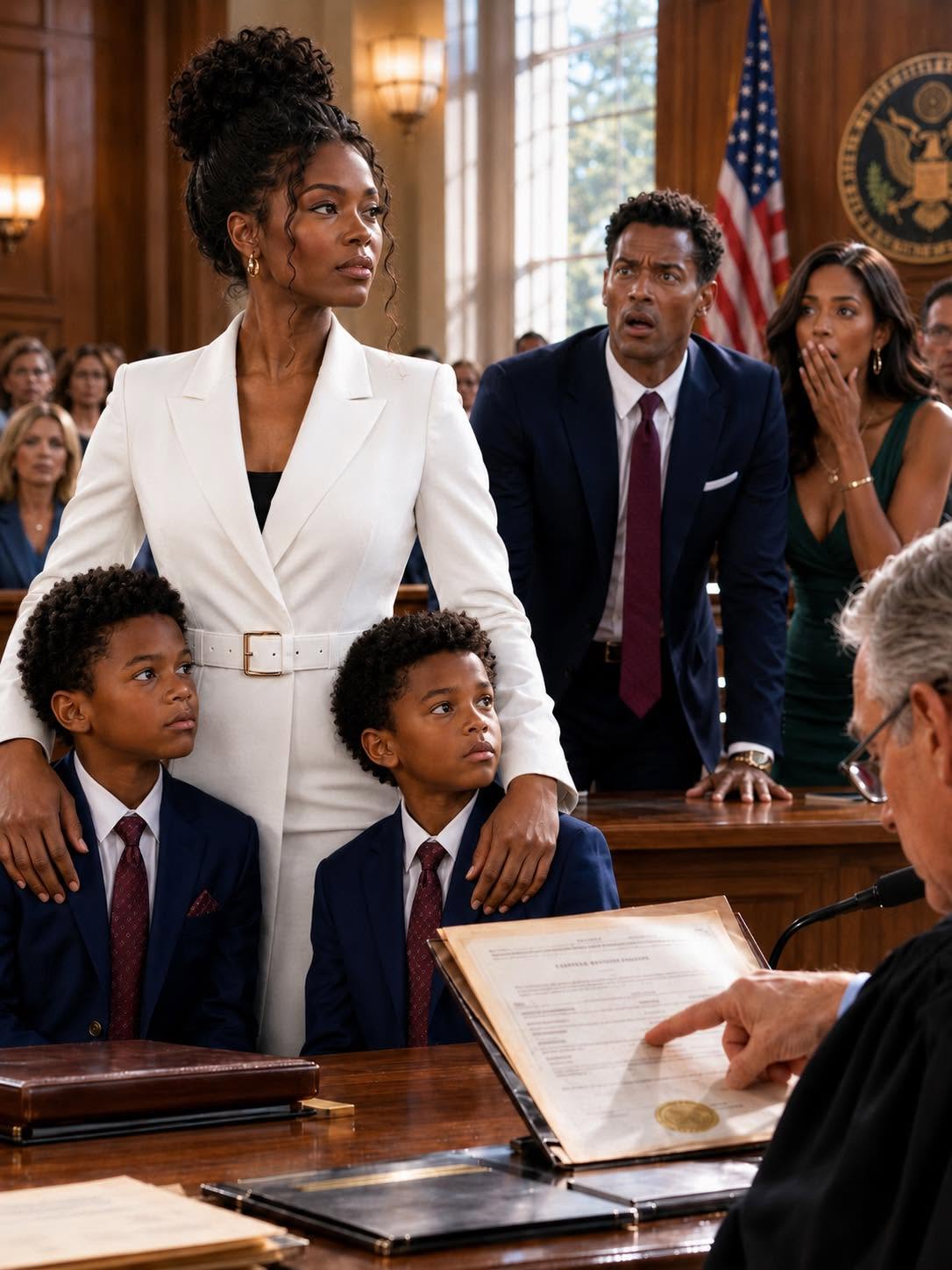
Judge Beckett did not issue a final custody order that day.
Instead, she ruled that the boys would remain with me during the school week. Gavin would have alternating weekends and one dinner visit each week.
Both parents were ordered to stop discussing the legal case with the children.
The judge also ordered a full review of the company’s ownership, financial records, and past transfers.
That order troubled Gavin more than the temporary custody arrangement.
There was no dramatic celebration when the hearing ended.
There was only the sound of folders closing, chairs moving, and the rain tapping against the courthouse windows.
Nolan and Parker walked directly to me.
Outside, Parker paused beside the car.
“Mom, did you really start Dad’s company?”
“I helped build it from the beginning.”
“Why didn’t you tell us?”
Because I had confused silence with peace.
Because I had protected Gavin’s image for so long that I nearly disappeared from my own story.
Instead, I said, “I wanted you to see your father as your father, not as someone I was fighting with.”
Parker thought about that.
“Can someone be good and still do something wrong?”
I brushed the rain from his hair.
“Yes. Most people are more complicated than one mistake.”
The Call That Night
After the boys went to sleep, I sat at the kitchen table with the court papers spread before me.
The house was quiet except for the soft hum of the refrigerator.
My phone rang.
Gavin.
I answered after the third ring.
“Cassandra.”
His voice sounded tired.
“Yes?”
“I never thought you would use those documents.”
“I never thought you would tell our sons I abandoned them.”
He was silent.
Then he said, “I panicked.”
“About losing what?”
“Everything.”
I looked around the kitchen.
Nolan’s homework sat beside a bowl of apples. Parker’s shoes were near the back door. Their ordinary belongings reminded me that the most important parts of my life had never been listed on a financial statement.
“You arrived with three attorneys and asked the court to take the boys from their home.”
“I didn’t think it would become this serious.”
“It became serious because you made it serious.”
He exhaled.
“What do you want?”
“Honesty. With the court, with the boys, and with yourself.”
He hesitated.
“And what do you want from the company?”
There it was.
Not an apology.
Not a question about Nolan or Parker.
The company.
“I have not decided.”
“The board will panic if these records become public.”
“Then perhaps the board should learn how the company was really created.”
His voice softened.
“You sound different.”
“I am different.”
“No,” he said. “You sound like the woman I met before all of this.”
For a moment, I remembered the younger Gavin standing beside our first shuttle van, laughing in the rain because the passenger door would not close properly.
I remembered believing we were building one life together.
“That woman trusted you,” I said.
He had no answer.
The Envelope at the Door
The next morning, I found a plain envelope taped to the front door.
There was no name and no return address.
Inside was a copy of an old company resolution dated nine years earlier.
The document claimed that I had approved a change in voting rights shortly before the twins were born.
My name appeared at the bottom.
The signature looked almost like mine.
Almost.
Across the top, someone had written in blue ink:
You need to learn what was changed while you were in the hospital.
My hands became cold.
A second sheet was folded behind the first.
It contained only one sentence.
Ask Gavin why your mother called him the night before she passed away.
Gavin had always told me he had not spoken to her that week.
Upstairs, Nolan and Parker laughed while brushing their teeth.
Their voices filled the house with the sound of an ordinary morning.
I stood alone in the doorway holding proof that the ownership records had opened only the first door.
And somewhere behind that door was a truth Gavin had spent years hoping I would never discover.
Staying quiet to protect a family can sometimes allow another person to rewrite your role, erase your sacrifices, and convince the world that everything you helped build belongs only to them.
True strength does not always enter a room loudly, because sometimes the strongest person is the one who has kept every record, remembered every promise, and waited for the right moment to speak.
A person’s unpaid work may never appear on a paycheck, but it can still carry a family, build a company, protect children, and create the foundation for someone else’s public success.
Trust is not a weakness, but continuing to ignore dishonesty after the truth becomes clear can slowly cost a person their confidence, their voice, and their rightful place in their own life.
Children should never be used as proof of victory in an adult conflict, because their sense of safety matters far more than either parent’s pride, reputation, or desire to win.
Financial independence is not only about money; it is also about recovering the freedom to make decisions without fear, pressure, or dependence on someone who no longer respects you.
The truth may remain hidden for years, but a carefully preserved document, a forgotten signature, or one honest question can expose what appearances were designed to conceal.
Protecting someone’s image should never require you to deny your own contribution, especially when that person begins using your silence as evidence that you never mattered.
A painful ending can also become the beginning of self-respect, because losing a marriage does not mean losing the intelligence, courage, and ability that existed long before that relationship began.
The most powerful victory is not taking everything from another person, but standing calmly in the truth, protecting your children, and refusing to disappear from your own story ever again.